St Albert the Great
Saint12th–13th century · Feast November 15
A Dominican scholar of extraordinary breadth who studied theology, philosophy and the natural world.
Dominican friar
Order of Preachers (Dominicans)
Germany
Saint13th century · Feast January 28
Also known as Tommaso d'Aquino, The Angelic Doctor, Thomas of Aquino, Thomas d’Aquino, Thomas de Aquino, Thomas Aquinas, St Thomas of Aquino, Thomas the Angelic Doctor, Doctor Angelicus, Doctor Communis, The Common Doctor
A Dominican friar whose prayerful search for truth united faith and reason, St Thomas Aquinas became one of the Church’s greatest theologians and showed that rigorous study can become an act of love for God and others.
God of truth and wisdom, through the intercession of St Thomas Aquinas, teach us to love you with our minds as well as our hearts. Give students patience, teachers clarity and scholars humility. Keep our search for knowledge rooted in prayer and ordered towards the good of others. When faith and reason seem divided, lead us beyond confusion into deeper truth. Through Christ present in the Eucharist, draw all our study and work towards friendship with you. Amen.
Thomas was born around 1224 or 1225 at the castle of Roccasecca, near Aquino, in the Kingdom of Sicily. He belonged to a noble family connected with the regional political and military world of southern Italy.
As a young child, Thomas was sent to the nearby Benedictine abbey of Monte Cassino for his first education. His family may have imagined that he would eventually obtain a prestigious ecclesiastical position connected with the abbey.
Political conflict later disrupted life at Monte Cassino, and Thomas continued his education at the University of Naples. The university had been founded by Emperor Frederick II and provided unusually direct access to works of Aristotle and to philosophical traditions transmitted through Muslim and Jewish scholars.
The intellectual world Thomas encountered at Naples was undergoing major change. Texts of Aristotle dealing with nature, metaphysics, ethics, the soul and knowledge were becoming increasingly available in Latin. Their arrival raised urgent questions about whether this philosophical account of reality could be reconciled with Christian revelation.
While in Naples, Thomas encountered the Order of Preachers, the relatively new religious community founded by St Dominic. The friars combined common prayer, voluntary poverty, serious study and itinerant preaching.
Thomas was drawn to this way of life and entered the Order of Preachers around 1244. His decision strongly opposed his family’s expectations. The Dominicans attempted to send him away from Naples, but members of his family intercepted him and kept him under supervision in their own residences for an extended period.
The purpose of this confinement was to persuade Thomas to abandon the mendicant order and accept a more socially prestigious path. He remained committed to his Dominican vocation. When the family’s opposition eventually eased, he returned to the friars.
In 1245, Thomas was sent to Paris, the leading centre of theological education in Western Europe. There he studied under the Dominican scholar St Albert the Great. Albert recognised Thomas’s exceptional intellectual ability and developed a lasting relationship with him.
Thomas followed Albert to Cologne when Albert was asked to establish a Dominican centre of study there. Under his guidance, Thomas studied Scripture, theology, Aristotle and the natural sciences.
Thomas was quiet, physically large and less outwardly impressive than some students. Later Dominican tradition remembers classmates underestimating him, while Albert recognised that his thought would eventually be heard throughout the world. The exact wording of these stories comes from later biographical tradition, but they express the contrast between Thomas’s modest manner and extraordinary ability.
After completing his formation and receiving priestly ordination, Thomas returned to Paris. He lectured on Scripture and on Peter Lombard’s Sentences, the standard theological textbook of the period.
In 1256, Thomas was admitted as a master of theology at Paris. The path was complicated by conflict between university masters and the mendicant orders. Some secular professors objected to Dominicans and Franciscans holding university chairs, questioning their poverty, organisation and place within academic life.
Thomas defended the legitimacy of religious orders dedicated to study and preaching. For him, contemplation was not intended to remain private. The Dominican vocation involved receiving truth through prayer and study and then sharing its fruits with others.
His teaching always began with Scripture. A medieval master of theology was first a teacher of the sacred page, not merely an abstract philosopher. Thomas wrote commentaries on biblical books and constantly drew theological arguments from the Bible, the Church Fathers and the liturgical life of the Church.
At the same time, Thomas engaged deeply with philosophy. He believed that truth could not ultimately contradict truth. Genuine discoveries reached through human reason could therefore assist theology, even when they came from thinkers outside Christianity.
His treatment of Aristotle was neither uncritical acceptance nor fearful rejection. Thomas distinguished ideas that could be received, those requiring correction and those incompatible with Christian teaching. Through this work he developed a powerful account of the harmony between faith and reason.
Thomas also engaged with Muslim and Jewish philosophical traditions, including thinkers such as Avicenna, Averroes and Maimonides. He disagreed with them on important questions but treated their arguments as intellectually serious rather than dismissing them merely because they came from outside Christianity.
In 1259, Thomas participated in the Dominican General Chapter at Valenciennes and helped establish a programme of studies for the Order. He then spent several years teaching and writing in Italy.
From 1261 to 1265, Thomas lived principally at Orvieto, where Pope Urban IV frequently resided. Urban asked him to compose liturgical texts for the newly established Feast of Corpus Christi.
Thomas’s Eucharistic poetry joined theological precision with prayer. Texts traditionally associated with this commission include portions of the hymns Pange Lingua, Sacris Solemniis, Verbum Supernum and the sequence Lauda Sion. Their verses continue to shape Catholic worship, especially during Eucharistic adoration and Benediction.
From 1265 to 1268, Thomas worked in Rome and directed a Dominican house of studies. During this period he began the Summa Theologiae, his most famous work.
The Summa was written principally as an organised introduction for students of theology rather than as an attempt to answer every possible religious question. It begins with God, creation and the human person; examines human action, virtue, grace and moral life; and then turns towards Christ, the sacraments and humanity’s return to God.
Thomas structures many questions by presenting objections, introducing an authoritative consideration, giving his own response and then answering the objections individually. This method allows opposing arguments to be heard clearly before they are answered.
His approach should not be reduced to cold logic. Thomas understood theology as wisdom ordered towards union with God. Reason clarifies, distinguishes and defends, but the final purpose of theology is contemplation and love.
Thomas returned to Paris in 1269 during intense controversy concerning Aristotle, the mendicant orders and the relationship between philosophy and theology. He debated other masters and wrote works addressing the unity of the human intellect, the eternity of the world and the nature of religious life.
He did not believe philosophy and theology were identical. Some truths, such as aspects of the existence of God and the moral order, can be approached through natural reason. Mysteries such as the Trinity and the Incarnation depend upon divine revelation. Faith raises reason beyond what it could discover alone without destroying reason’s proper integrity.
In 1272, Thomas returned to Naples to establish a Dominican centre of theological study. He continued teaching, preaching and writing the Summa.
His productivity was extraordinary. His surviving works include biblical commentaries, philosophical commentaries, disputed questions, university lectures, sermons, short theological works, the Summa contra Gentiles and the unfinished Summa Theologiae.
Thomas relied upon secretaries because he dictated much of his work, sometimes working on several texts during the same period. His close collaboration with friars such as Reginald of Piperno also reveals that his intellectual life was sustained by friendship and community rather than solitary brilliance alone.
His prayer was inseparable from his study. Early biographies describe him bringing difficult questions before the altar or crucifix and returning to his work only after prayer.
One traditional account relates that while Thomas prayed before a crucifix in Naples, Christ affirmed what he had written and asked what reward he desired. Thomas answered that he wanted nothing except Christ himself. Although preserved through early hagiographical witnesses rather than Thomas’s own writing, the account expresses the Christ-centred purpose of his theology.
Thomas had a particularly deep devotion to the Eucharist. He celebrated Mass with great reverence and understood the Eucharist as the sacramental presence of Christ’s sacrifice, the nourishment of the Church and a foretaste of eternal communion with God.
In December 1273, after an intense spiritual experience while celebrating Mass, Thomas stopped his major writing projects. When Reginald urged him to continue, early witnesses report that Thomas said his writings appeared like straw compared with what had been revealed to him.
This statement did not mean that he rejected theology or considered his works useless. It expressed the distance between even the finest human language about God and the reality of God encountered in contemplation.
Early in 1274, Pope Gregory X called Thomas to participate in the Second Council of Lyon. Although already physically unwell, he began the journey north.
During the journey, Thomas’s condition worsened. He was received by the Cistercian monks of Fossanova Abbey, where he spent his final days.
Thomas died at Fossanova on 7 March 1274 after receiving the sacraments. He was approximately forty-nine years old.
His death did not immediately end controversy over his thought. In 1277, authorities in Paris and Oxford condemned collections of philosophical and theological propositions, some of which were associated directly or indirectly with positions Thomas had defended. His teaching nevertheless continued to gain influence, particularly within the Dominican Order.
Pope John XXII canonised Thomas at Avignon on 18 July 1323. His remains were translated to the Dominican church in Toulouse on 28 January 1369.
Pope St Pius V declared him a Doctor of the Church in 1567. He became known as the Angelic Doctor because of the theological depth and spiritual purity associated with his work, and as the Common Doctor because of his broad authority within Catholic theology.
In 1880, Pope Leo XIII formally proclaimed Thomas patron of Catholic universities, academies, colleges and schools. His approach has repeatedly been recommended by the Church, not because every later theological problem can be solved by repeating medieval formulas, but because he provides a model of intellectual honesty, confidence in truth and disciplined dialogue between faith and reason.
Thomas’s legacy extends into theology, philosophy, ethics, law, political thought, sacramental teaching, metaphysics, education and Christian spirituality. His writings continue to be debated, translated and developed across different philosophical schools.
His lasting importance cannot be separated from his holiness. Thomas did not study merely to become impressive or win arguments. He sought truth as a path towards God and treated teaching as a work of charity: first contemplating truth and then sharing its fruits with others.
Thomas lived during a period of major intellectual, religious and social change in thirteenth-century Europe. Cities and universities were expanding, new religious orders were developing and Latin scholars were gaining wider access to Greek, Arabic and Jewish philosophical traditions.
The University of Paris had become the leading centre of theological study in Western Europe. University teaching was structured through lectures, public disputes, commentaries and closely argued questions.
The works of Aristotle were transforming medieval education. Many texts had reached Latin readers through translations and commentaries produced in the Islamic world. Some Christians welcomed Aristotle enthusiastically, while others feared that his philosophy threatened doctrines such as creation, personal immortality and divine providence.
Thomas sought neither to baptise every Aristotelian conclusion nor to reject philosophy because it had non-Christian origins. He argued that truths reached by sound reason cannot ultimately contradict truths revealed by God.
The newly founded mendicant orders also generated controversy. Unlike monks tied principally to stable rural monasteries, Dominicans and Franciscans lived within cities, travelled, preached and taught in universities while professing religious poverty.
Thomas’s work emerged from the Dominican conviction that serious study could serve preaching. Intellectual formation was not merely personal advancement but preparation to communicate the Gospel responsibly.
Political conflict between emperors, kings, popes, cities and noble families shaped the world in which Thomas travelled. His own family expected his religious career to preserve or increase its influence, making his decision to join a mendicant order especially disruptive.
Thomas also lived before the modern division between philosophy, theology, natural science, psychology, ethics and political theory. These disciplines remained closely connected within a unified search for wisdom.
Contemplation ordered towards preaching; love of truth; harmony between faith and reason; Eucharistic devotion; prayer before study; Scripture as the foundation of theology; Dominican common life; intellectual humility; friendship; disciplined teaching; confidence in grace; love understood as friendship with God; and the desire to share the fruits of contemplation with others.
St Thomas Aquinas speaks especially to students who feel overwhelmed by complicated material, demanding courses or the pressure to understand everything immediately. His life shows that patient, structured study can itself become an act of love.
He is particularly relevant to people who believe faith requires them to stop asking serious questions. Thomas did not protect Christianity by avoiding philosophy. He examined difficult arguments carefully and trusted that truth could withstand investigation.
His work is also helpful to people who assume that scientific or philosophical discoveries must automatically threaten religion. Thomas distinguished the methods and limits of different forms of knowledge while insisting that genuine truth cannot finally contradict genuine truth.
For university students, researchers and academics, Thomas offers a model of intellectual ambition ordered towards service rather than status. Knowledge becomes spiritually dangerous when separated from humility and love.
His method can help people navigating disagreement. Thomas frequently presents an opposing argument in a strong form before responding to it. He does not begin by caricaturing the person with whom he disagrees.
This makes him relevant to online debate, political polarisation and religious apologetics. His approach encourages careful definition, accurate representation of opposing views and patient distinction rather than slogans.
Thomas also speaks to people experiencing information overload. He organised enormous bodies of material by identifying first principles, asking clear questions and distinguishing issues that were often being confused.
He is meaningful to teachers, lecturers, catechists and preachers. He believed that teaching should arise from contemplation and should communicate truth in a way ordered towards the learner’s good.
For people facing family opposition to a vocation, Thomas demonstrates quiet perseverance. He did not respond to pressure by abandoning his calling or by treating his family with contempt.
His Eucharistic devotion is important because it prevents his profile from becoming merely academic. His theological study grew within the Mass, prayer and adoration rather than replacing them.
The unfinished Summa can encourage writers, researchers and people working on enormous projects. Human work can be genuinely valuable without becoming complete or perfect.
Thomas’s final spiritual experience also offers a corrective to intellectual pride. Language about God matters, but God always exceeds every concept, argument and system.
He is relevant to people considering questions in medicine, law, economics, artificial intelligence and technology. Thomas cannot provide ready-made answers to inventions that did not exist in his period, but his accounts of human dignity, purpose, virtue, natural law, responsibility and the common good offer tools for careful moral reasoning.
His thought should not be used as a weapon to silence every theological disagreement. A genuinely Thomistic approach includes patient inquiry, engagement with new knowledge, careful distinction and willingness to receive truth from unexpected sources.
People turn to St Thomas Aquinas in matters of:
c. 1224–1225
Born at his family’s castle at Roccasecca near Aquino.
c. 1230
Sent to the Benedictine abbey of Monte Cassino for his early education.
1239
Begins studying at the University of Naples after political conflict disrupts Monte Cassino.
c. 1244
Joins the Order of Preachers in Naples.
c. 1244–1245
Is detained by his family while they attempt to persuade him to abandon the Dominican vocation.
1245
Travels to Paris and studies under St Albert the Great.
1248
Follows Albert to the Dominican centre of study in Cologne.
c. 1252
Returns to Paris and begins advanced teaching on Scripture and Peter Lombard’s Sentences.
1256
Admitted as a master of theology at the University of Paris.
1259
Participates in the Dominican General Chapter at Valenciennes and helps shape the Order’s programme of studies.
1261–1265
Lives principally at Orvieto and works within the papal court of Urban IV.
c. 1264
Composes liturgical texts associated with the Feast of Corpus Christi at the request of Pope Urban IV.
1265–1268
Directs a Dominican study house in Rome and begins the Summa Theologiae.
1269
Returns to Paris for a second period of university teaching.
1272
Returns to Naples to establish and direct a Dominican centre of theological studies.
December 1273
Experiences an intense spiritual event and ceases work on the Summa Theologiae.
early 1274
Begins travelling towards the Second Council of Lyon at the summons of Pope Gregory X.
7 March 1274
Dies at the Cistercian Abbey of Fossanova.
18 July 1323
Canonised by Pope John XXII at Avignon.
28 January 1369
His remains are solemnly translated to the Dominican church in Toulouse.
11 April 1567
Declared a Doctor of the Church by Pope St Pius V.
4 August 1880
Proclaimed patron of Catholic universities, academies, colleges and schools by Pope Leo XIII.
January 28 · Memorial · Global
St Thomas Aquinas, Priest and Doctor of the Church, Priest, Religious and Doctor of the Church
Memorial in the General Roman Calendar
Commons Common of Pastors: For One Pastor · Common of Doctors of the Church
January 28 · Feast · Religious order
St Thomas Aquinas, Priest and Doctor of the Church, Priest, Religious and Doctor of the Church
Feast in the proper calendar of the Order of Preachers
Commons Common of Pastors: For One Pastor · Common of Doctors of the Church
Source-quality status: verified
Saint12th–13th century · Feast November 15
A Dominican scholar of extraordinary breadth who studied theology, philosophy and the natural world.
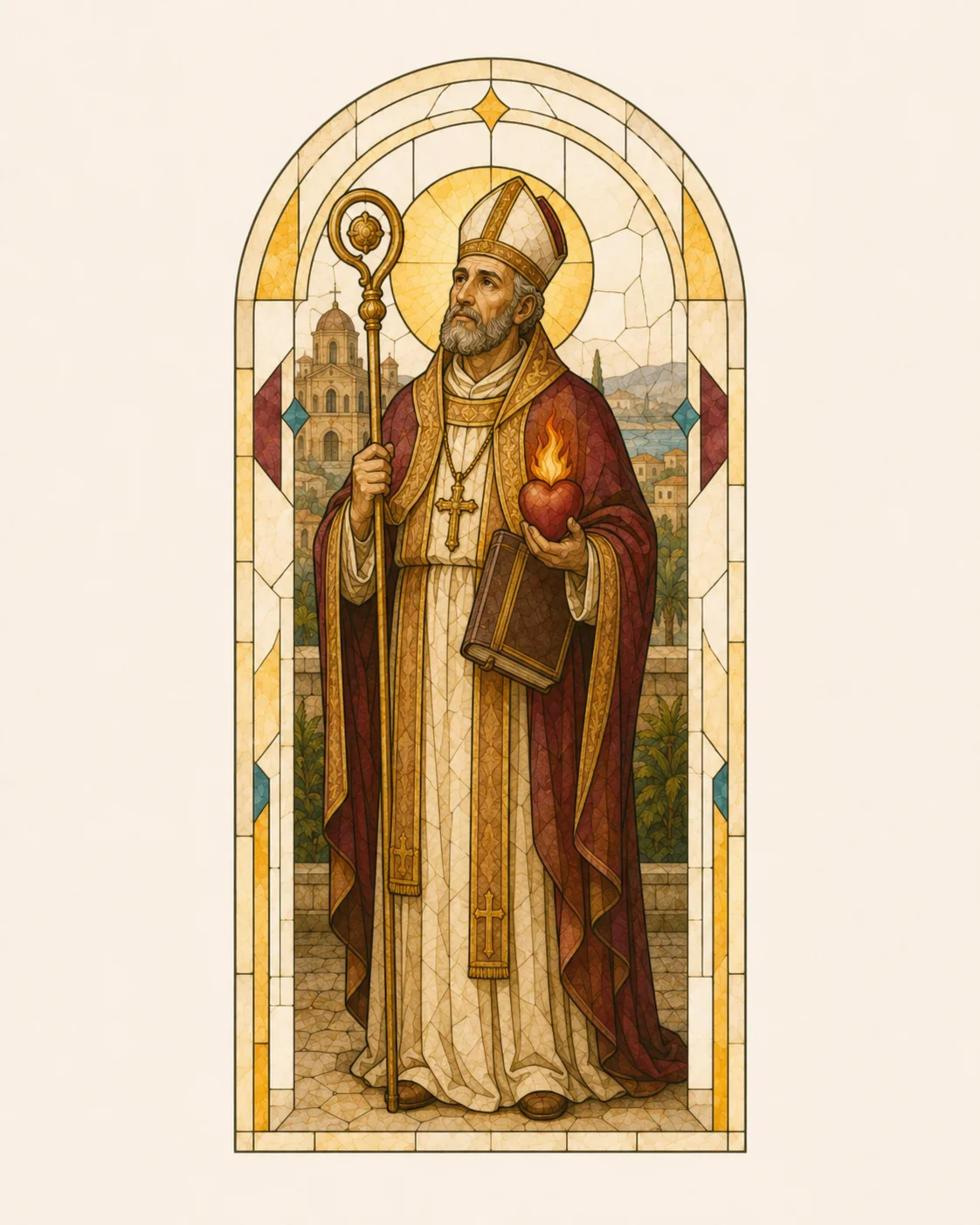
Saint5th century · Feast August 28
A restless seeker who found Christ after years of intellectual and moral struggle, St Augustine became a bishop, pastor and writer whose teaching on grace, love and the human heart profoundly shaped Western Christianity.
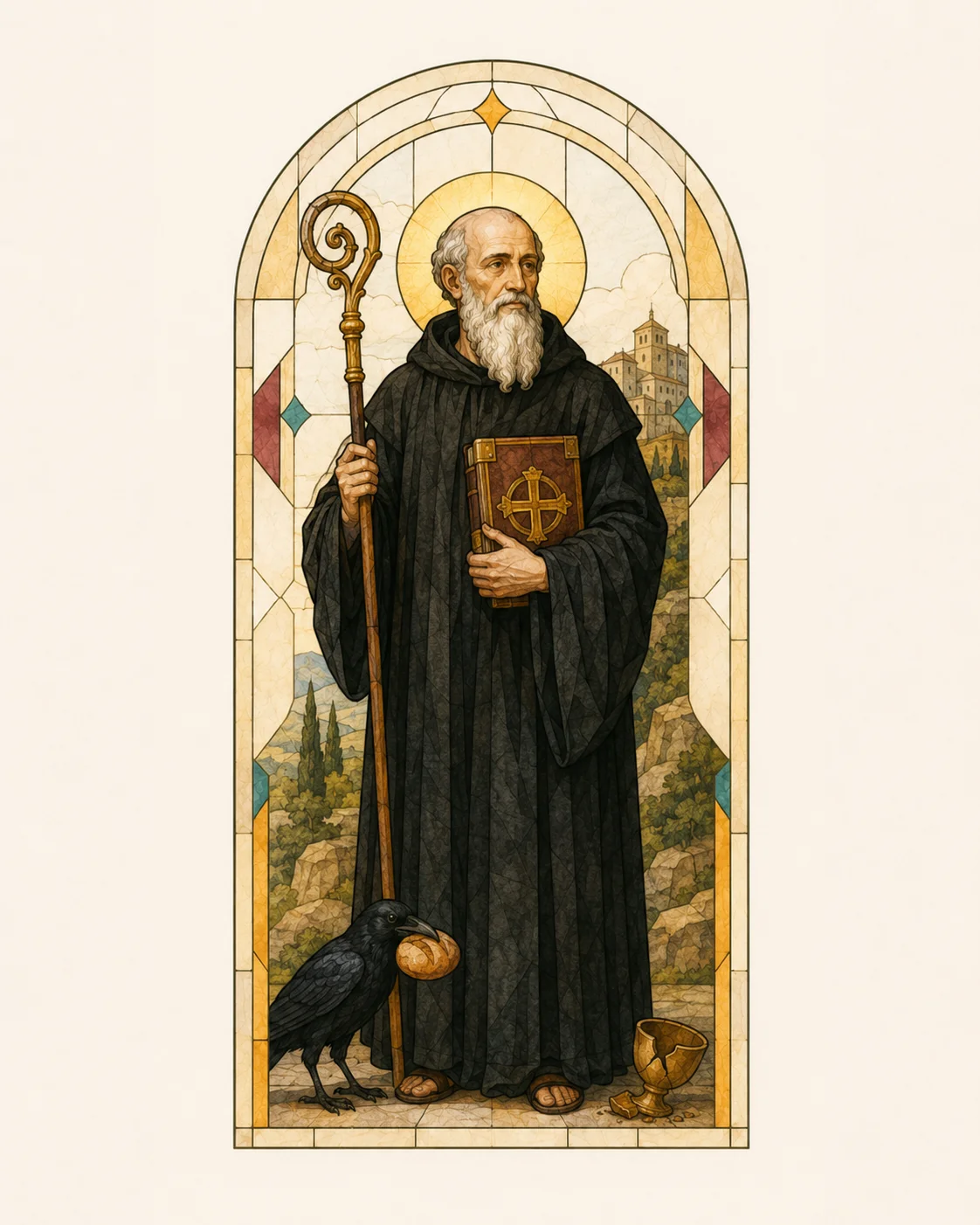
Saint6th century · Feast July 11
A monk and abbot who transformed a solitary search for God into a lasting school of prayer, work, hospitality and community through the Rule that shaped Western monasticism.
Saint13th century · Feast July 15
A Franciscan theologian and leader who joined rigorous study with contemplation and wonder before creation.
Saint14th century · Feast April 29
A Dominican laywoman, mystic and Doctor of the Church who combined intense prayer, care for the sick and fearless counsel to Church and political leaders.
Saint12th–13th century · Feast August 8
A Spanish priest who founded the Dominicans and joined study, prayer, community and preaching.