Thematic
Finding Peace in Anxious Seasons
A short pathway with saints whose lives passed through anxious seasons — and the small practices that steadied them.
5 days8 min / day
Saint6th century · Feast July 11
Also known as Benedict of Norcia, St Benedict, St Benedict the Abbot, Benedictus of Nursia, San Benedetto da Norcia
A monk and abbot who transformed a solitary search for God into a lasting school of prayer, work, hospitality and community through the Rule that shaped Western monasticism.
God of peace, through the intercession of St Benedict, teach us to listen for your voice and to order our lives around what truly matters. Give us faithfulness in prayer, dignity in work, patience in community and generosity towards every stranger. Help us to lead without pride, serve without resentment and prefer nothing to the love of Christ. Amen.
Benedict was born around 480 in Nursia, the mountain town now known as Norcia in central Italy. Christian tradition associates him closely with his sister, St Scholastica, who is often described as his twin. Most of what is known about Benedict’s life comes from the second book of the Dialogues of Pope St Gregory the Great, written several decades after Benedict’s death.
Gregory’s account is a work of Christian hagiography rather than a modern historical biography. Its purpose is to reveal Benedict’s holiness and demonstrate God’s action through his life. The broad outline of Benedict’s journey is historically important, but many individual dates, conversations and miracles belong to the tradition preserved by Gregory and should be presented with that qualification.
As a young man, Benedict was sent to Rome to receive an education. He became troubled by the moral environment he encountered and abandoned his studies rather than allow ambition and social pressure to draw him away from the life he believed God was asking him to pursue.
He initially travelled to Enfide, usually identified with modern Affile. From there he withdrew further into solitude near Subiaco. Assisted by a monk named Romanus, Benedict lived for approximately three years in a cave later known as the Sacro Speco, or Holy Cave. This period of silence, prayer and ascetic discipline formed the foundation of his spiritual life.
Benedict’s reputation for holiness eventually spread, and monks from a nearby community asked him to become their abbot. According to Gregory, the community soon resisted the discipline Benedict attempted to introduce. Some monks tried to poison his wine, but the cup shattered when Benedict blessed it with the sign of the cross. Recognising that the community would not accept his direction, he returned to solitude.
Disciples gradually gathered around Benedict at Subiaco. He organised them into a network traditionally described as twelve small monasteries, each containing twelve monks. His movement therefore developed from solitary prayer into structured community life.
Benedict later left Subiaco and travelled south to Monte Cassino. Around 529, he established a monastery on the mountain above the town of Cassino. Gregory describes Benedict removing the remains of pagan worship from the site and establishing a Christian community centred upon prayer, instruction, hospitality and common life.
At Monte Cassino, Benedict wrote the work now known as the Rule of St Benedict. The Rule contains a prologue and seventy-three chapters. It draws upon Scripture and earlier Christian monastic traditions while reflecting Benedict’s own experience as a monk and abbot.
The Rule establishes a daily rhythm of common prayer, meditative reading, manual work, meals, rest and service. It gives detailed guidance concerning leadership, obedience, humility, silence, care for sick members, treatment of possessions, admission of new members, correction of faults and the reception of guests.
Benedict’s approach is demanding but marked by moderation. The abbot must exercise real authority, yet he must listen to the community, consider individual weakness and lead through example. The strong should be challenged without causing the weak to become discouraged. Guests, particularly people who are poor or travelling, are to be welcomed as Christ.
The popular phrase “ora et labora,” meaning “pray and work,” does not appear as a direct quotation in the Rule. It is a later summary of the Benedictine balance between prayer, reading, work and community life. The fuller Benedictine tradition is sometimes expressed as “ora, labora et lege”: pray, work and read.
Gregory records many miracles associated with Benedict. These include the broken cup of poisoned wine, a raven carrying away poisoned bread, water flowing where monks needed it and Benedict perceiving events occurring far away. The stories intentionally recall biblical prophets and present Benedict as a holy leader through whom God continued to guide the Church.
Benedict remained closely connected to his sister Scholastica, who led a community of religious women. Gregory recounts a final meeting during which Scholastica wished to continue their spiritual conversation through the night. When Benedict initially refused, she prayed and a sudden storm prevented his departure. Three days later, Benedict reportedly saw her soul ascending to heaven in the form of a dove.
Tradition holds that Benedict foresaw his own death. He asked for his grave to be prepared and, after receiving Holy Communion, died in the monastery chapel while standing in prayer and being supported by his brothers. His death is traditionally associated with March 21 around the year 547, although the precise year and date cannot be established historically.
Benedict did not personally create the later network now called the Order of Saint Benedict. Over the following centuries, however, his Rule was adopted by communities across Western Europe. Benedictine monasteries became centres of prayer, learning, hospitality, agriculture, manuscript preservation and service.
In 1964, Pope Paul VI proclaimed Benedict the principal patron of Europe. The title recognised the immense spiritual and cultural influence exercised through communities that followed his Rule. Benedict remains a guide not only for monks and nuns but for families, leaders, workers and anyone seeking a stable rhythm of prayer, responsibility and shared life.
Benedict lived during the collapse of Roman political authority in Western Europe. The Western Roman Empire formally ended in 476, and Italy experienced changing rulers, warfare, migration and institutional instability.
The Roman educational and civic systems in which Benedict began his life were weakening. Communities could no longer rely upon the social order that had governed the Mediterranean world for centuries.
Christian monasticism was already well established before Benedict. It had developed in Egypt, Syria, Palestine and other parts of the Christian world before spreading westward. Benedict inherited this existing tradition rather than inventing it.
His Rule emerged in a period when monasteries could provide stability, education, hospitality, agricultural organisation and spiritual formation amid wider social disruption. Its balance of structure and adaptability helped it survive far beyond Benedict’s own time and region.
Listening for God through Scripture, silence and community; stability in one place and vocation; obedience shaped by discernment; humility; liturgical prayer; lectio divina; responsible work; hospitality; moderation; care for the sick and vulnerable; peaceful community life; and preferring Christ above every other attachment.
St Benedict is especially relevant to people whose lives feel distracted, disorganised or overwhelmed. His Rule demonstrates that spiritual growth is supported by a realistic daily rhythm rather than by relying only upon motivation or intense religious experiences.
He speaks to people struggling to balance work, prayer, family, rest and service. Benedictine spirituality does not treat work as an interruption to holiness, but neither does it allow productivity to consume the whole person. Prayer, reading, community and rest place work within a larger human purpose.
Benedict is an important companion for leaders, managers, founders and people responsible for teams. His Rule requires leaders to listen, consult others, consider individual circumstances and exercise authority for the good of the community rather than personal status.
His teaching is also valuable for people living in shared households, religious communities or difficult workplaces. Stability means learning to remain faithful and grow within real relationships rather than constantly escaping when other people become inconvenient.
For people exhausted by digital noise, constant communication or fragmented attention, Benedict offers silence, deep reading and regular prayer. His approach encourages people to be fully present to the task, person or prayer before them.
His hospitality challenges fear and indifference towards strangers, travellers, refugees and people in poverty. Benedict’s Rule asks communities to recognise Christ particularly in those who arrive needing welcome and care.
Benedict is also relevant to people recovering from instability, career disruption or institutional collapse. He did not attempt to restore the Roman world exactly as it had been. He formed small, faithful communities capable of preserving what was good and building something durable within changing circumstances.
People turn to St Benedict of Nursia in matters of:
c. 480
Born in Nursia, the town now known as Norcia in central Italy.
c. 500
Leaves his studies in Rome and begins seeking a life centred upon prayer and separation from worldly ambition.
c. 500–503
Lives as a hermit in a cave near Subiaco, assisted by the monk Romanus.
c. 503
Accepts leadership of a nearby monastic community but leaves after the poisoning attempt described by Gregory the Great.
c. 505–529
Gathers disciples and establishes a network of monasteries around Subiaco.
c. 529
Leaves Subiaco and establishes the monastery of Monte Cassino.
c. 530–547
Composes the Rule of St Benedict, drawing upon Scripture, monastic tradition and his experience as an abbot.
c. 547
Meets St Scholastica for their final spiritual conversation, as recounted by Gregory the Great.
c. 547
Dies at Monte Cassino after receiving Holy Communion, according to Benedictine tradition.
c. 593–594
Pope St Gregory the Great writes the Dialogues, devoting Book II to Benedict’s life and miracles.
24 October 1964
Pope Paul VI proclaims St Benedict the principal patron of Europe.
July 11 · Memorial · Global
St Benedict, Abbot
Memorial in the General Roman Calendar
March 21 · Feast · Religious order
Transitus of St Benedict
Traditional Feast of the Transitus in the Benedictine calendar; some monasteries celebrate it as a solemnity
Source-quality status: verified
Thematic
A short pathway with saints whose lives passed through anxious seasons — and the small practices that steadied them.
Saint11th–12th century · Feast August 20
A charismatic Cistercian abbot and spiritual writer with major influence in monastic reform and European politics.
Saint6th–7th century · Feast September 3
A Roman administrator and monk reluctantly drawn into papal leadership during crisis.
Saint11th–12th century · Feast September 17
A Benedictine abbess, composer, writer and Doctor of the Church who joined theology, music and nature.
Saint5th–6th century · Feast February 10
The sister of St Benedict, remembered through a final conversation in which love outweighed a rigid schedule.
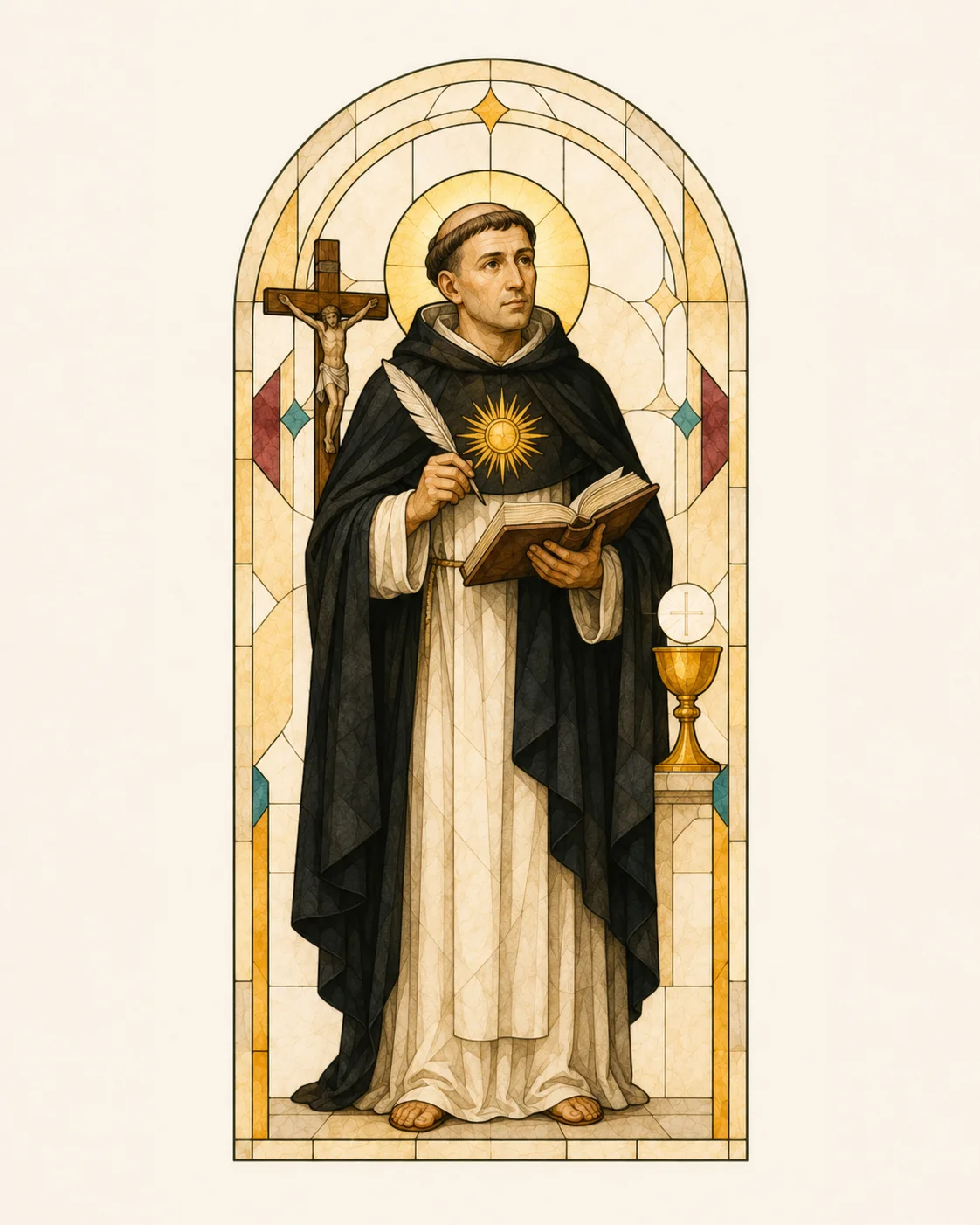
Saint13th century · Feast January 28
A Dominican friar whose prayerful search for truth united faith and reason, St Thomas Aquinas became one of the Church’s greatest theologians and showed that rigorous study can become an act of love for God and others.