Thematic
Saints for Family Life
Married saints, parents and family companions for the honest work of everyday family life.
7 days10 min / day
Saint20th century · Feast April 28
Also known as Gianna Molla, Gianna Beretta, Giovanna Francesca Beretta, Saint Gianna, Santa Gianna Beretta Molla
An Italian physician, wife and mother who lived medicine and family life as Christian vocations, St Gianna united professional service, joyful faith and courageous love within the ordinary responsibilities of modern life.
God of life and love, through the intercession of St Gianna Beretta Molla, teach us to recognise every person as your gift. Strengthen physicians and all who care for the sick. Sustain married couples, parents and families facing difficult decisions. Give us wisdom to unite faith with professional responsibility, courage to protect the vulnerable and joy in serving you through the ordinary duties of each day. Amen.
Gianna Beretta was born in Magenta, near Milan, on 4 October 1922. She was the tenth of thirteen children born to Alberto Beretta and Maria De Micheli. She was baptised Giovanna Francesca seven days later in the Basilica of St Martin in Magenta.
Her parents were deeply committed Catholics and members of the Franciscan Third Order. They taught their children to regard life as a gift from God, to trust divine Providence and to remain attentive to people who were poor, sick or otherwise in need.
The Beretta family moved several times during Gianna’s childhood, living in Milan, Bergamo and Genoa. She received her First Holy Communion in Bergamo on 4 April 1928 and was confirmed on 9 June 1930. The Eucharist, personal prayer and devotion to the Blessed Virgin Mary became enduring foundations of her spiritual life.
Gianna enjoyed music, painting, skiing, mountaineering and excursions into nature. Her holiness did not develop through withdrawal from ordinary enjoyment but through a grateful and disciplined engagement with life.
During spiritual exercises in March 1938, when she was fifteen, she recorded resolutions concerning prayer, purity, obedience to God’s will and service. These exercises became an important point in the development of her personal vocation.
Her education was interrupted for a year because of poor health. Her family also experienced grief and disruption. Her older sister Amalia died in 1937, and wartime bombing contributed to the family’s departure from Genoa. Gianna lost both parents in 1942, only a few months apart.
After completing secondary school, she enrolled in medicine and surgery at the University of Milan in November 1942. She later continued her studies at the University of Pavia, receiving her medical degree on 30 November 1949.
Throughout university, Gianna maintained a disciplined spiritual and apostolic life. She attended Mass, prayed the Rosary, spent time before the Blessed Sacrament and worked with young people through Catholic Action. She also assisted elderly and disadvantaged people through the Society of St Vincent de Paul.
In June 1950, Gianna was registered with the Medical Association of Milan. The following month she opened a medical clinic in Mesero. She obtained her specialist qualification in paediatrics from the University of Milan on 7 July 1952.
Gianna considered medicine a mission rather than merely a profession. She devoted particular attention to mothers, children, elderly patients and people unable to afford care. She attempted to remain professionally competent while treating each patient as a whole person rather than as a medical problem.
For a time, Gianna considered joining her brother, Father Alberto Beretta, a Capuchin priest and physician serving as a missionary in Brazil. She hoped to support his medical work, particularly among women and children. Her health and the advice of her spiritual director eventually led her to conclude that this was not her vocation.
Gianna continued praying for clarity about her future. She did not regard marriage as a lesser alternative to missionary or religious life. She came to recognise it as the specific vocation through which she was called to love God and others.
On 8 December 1954, she met the engineer Pietro Molla at a public celebration in Mesero. They became engaged on 11 April 1955. Their surviving letters reveal a relationship marked by affection, humour, spiritual purpose and practical preparation for family life.
Gianna and Pietro were married on 24 September 1955 in the Basilica of St Martin in Magenta. They settled in Ponte Nuovo di Magenta, close to the industrial works directed by Pietro.
Gianna continued practising medicine after marriage. From 1956 she also served without payment at a mothers’ consultation centre and nursery, and provided voluntary medical care in local schools.
Their first child, Pierluigi, was born on 19 November 1956. Maria Zita, known as Mariolina, followed on 11 December 1957, and Laura was born on 15 July 1959.
Gianna attempted to balance the real demands of marriage, motherhood, medicine, prayer and recreation. Her life included tiredness, professional responsibility and the daily organisation required by a growing family. Her holiness was expressed largely through these ordinary commitments rather than through public religious achievements.
In September 1961, near the end of the second month of another pregnancy, doctors discovered a large fibroma in her uterus. The tumour was benign, but its location created serious risks for both Gianna and the developing child.
Gianna did not reject medical care. She underwent surgery at San Gerardo Hospital in Monza on 6 September 1961. She asked the surgeon to remove the fibroma while preserving her pregnancy, despite knowing that this was the medically riskier course for her.
The operation succeeded in removing the tumour without ending the pregnancy. During the following seven months, Gianna continued her responsibilities as a doctor, wife and mother while praying that both she and the child would survive.
Shortly before the birth, Gianna told Pietro that, should an emergency make it impossible to save both lives, the medical team should protect the child. This request has become the best-known episode of her life, but it should be understood within her longstanding respect for life, her medical knowledge, her maternal responsibility and her trust in Providence.
Gianna was admitted to San Gerardo Hospital on Good Friday, 20 April 1962. An attempt was made to induce labour because this was initially judged to be the less dangerous method of delivery. When it was unsuccessful, her daughter Gianna Emanuela was delivered by Caesarean section on the morning of 21 April.
Within hours of the birth, Gianna developed a high fever and severe abdominal pain caused by septic peritonitis. Doctors continued treating her, but her condition deteriorated throughout the following week.
At her request, Gianna was returned to the family home at Ponte Nuovo before dawn on 28 April. She died there at approximately eight o’clock in the morning, aged thirty-nine.
Gianna was buried at the cemetery in Mesero. Her daughter Gianna Emanuela survived. The family experienced further grief when Mariolina died from acute kidney disease in February 1964 at the age of six.
The Church’s recognition of Gianna’s holiness was based upon her entire life of Christian virtue: her prayer, professional service, marriage, motherhood, charitable work, vocational discernment and final act of maternal love. She was not canonised merely because she died following childbirth.
Pope St John Paul II beatified Gianna on 24 April 1994 during the International Year of the Family. She was canonised on 16 May 2004, with Pietro and their children present.
In his canonisation homily, John Paul II presented Gianna as a witness to conjugal love lived as a divine calling and to the complete gift of self. Her life shows that sanctity can develop through medical practice, marriage, parenthood, friendship, recreation and ordinary service undertaken with faith.
Gianna came of age during Fascist rule, the Second World War and Italy’s difficult post-war reconstruction. Wartime bombing affected her family’s movements, and she began university studies in 1942 while the conflict was still underway.
Catholic Action provided lay Catholics with organised spiritual formation and opportunities for apostolic service. Gianna’s involvement formed her understanding that laypeople were called to pursue holiness actively within education, work, family and public life.
Modern medicine was developing rapidly, but antibiotics, surgical care, obstetrics and intensive treatment were not yet as advanced as they are today. Septic peritonitis remained a life-threatening complication even when treatment was provided.
Gianna’s life also belongs to a period in which women were entering university education and professional medicine in increasing numbers while still carrying strong cultural expectations concerning marriage and domestic life.
Her witness therefore emerged from the practical challenge of integrating professional competence, marriage, parenting, prayer and service rather than choosing between a serious vocation to work and a serious vocation to family life.
Eucharistic devotion; Marian prayer; vocational discernment; marriage understood as a sacrament and calling; medicine lived as a mission; joyful gratitude for creation; service to the sick and poor; Catholic Action; prayerful trust in Providence; responsible motherhood; professional competence; and holiness pursued through ordinary family and working life.
St Gianna is especially relevant to people trying to balance professional work, marriage, parenting, prayer and personal health. Her life does not offer an effortless formula for achieving balance. It shows that ordinary responsibilities can become places of love, discernment and holiness even when they compete for time and energy.
She speaks strongly to physicians, nurses, paediatricians, midwives and other medical professionals who want to treat their work as a service to complete human persons rather than a technical occupation alone.
Gianna is meaningful to working mothers who feel pressured to prove that professional commitment and serious motherhood cannot coexist. She took both responsibilities seriously without pretending that either was easy.
Her courtship and marriage make her a useful companion for engaged couples and spouses. Her letters reveal affection, attraction, humour, planning and a shared desire to build a Christian family.
She also speaks to people discerning between several good possibilities. Gianna seriously considered missionary medicine in Brazil, accepted advice that it was not the right path and remained open until she recognised marriage as her vocation.
Her final pregnancy is particularly meaningful to families experiencing a difficult diagnosis, high-risk pregnancy, miscarriage, fertility concerns or complicated medical decisions.
Her story should never be used to tell pregnant women that accepting medically indicated treatment is sinful or that holiness requires refusing every intervention that carries risk for an unborn child. Gianna herself received surgery, hospital care, attempted induction, Caesarean delivery and treatment for infection.
Her final decision was a personal act of informed conscience within a particular medical situation. It should not be simplified into a universal medical instruction or used to judge families facing different diagnoses.
Gianna’s whole life also challenges the tendency to remember women saints only through suffering or death. She was a trained physician, active lay leader, wife, mother, skier, mountaineer, artist and friend with a strong enjoyment of life.
She shows that holiness does not require a person to abandon professional ambition, recreation, romantic love or family happiness. These can all be received and ordered as gifts.
Her death also makes her a companion for widowed spouses, children who lose a parent and families whose joy at a birth is accompanied by grief.
People turn to St Gianna Beretta Molla in matters of:
4 October 1922
Born in Magenta, Lombardy, to Alberto Beretta and Maria De Micheli.
11 October 1922
Baptised Giovanna Francesca in the Basilica of St Martin in Magenta.
1962
Dies shortly after her daughter's birth
4 April 1928
Receives her First Holy Communion in Bergamo.
9 June 1930
Receives Confirmation in Bergamo Cathedral.
16–18 March 1938
Participates in spiritual exercises that strongly shape her developing vocation.
29 April 1942
Her mother, Maria, dies.
10 September 1942
Her father, Alberto, dies.
November 1942
Enrols in medicine and surgery at the University of Milan.
1945
Continues her medical studies at the University of Pavia.
30 November 1949
Receives her degree in medicine and surgery.
20 June 1950
Is entered on the professional register of the Medical Association of Milan.
1 July 1950
Opens a medical clinic in Mesero.
7 July 1952
Qualifies as a specialist in paediatrics at the University of Milan.
8 December 1954
Meets Pietro Molla at a public celebration in Mesero.
11 April 1955
Celebrates her formal engagement to Pietro.
24 September 1955
Marries Pietro Molla in the Basilica of St Martin in Magenta.
19 November 1956
Gives birth to their son Pierluigi.
11 December 1957
Gives birth to Maria Zita, known as Mariolina.
15 July 1959
Gives birth to their daughter Laura.
6 September 1961
Undergoes surgery to remove a uterine fibroma while preserving her pregnancy.
20 April 1962
Is admitted to San Gerardo Hospital in Monza for the birth.
21 April 1962
Gives birth by Caesarean section to Gianna Emanuela and develops septic peritonitis.
28 April 1962
Dies at the family home in Ponte Nuovo di Magenta.
24 April 1994
Beatified by Pope St John Paul II as a mother of a family.
16 May 2004
Canonised by Pope St John Paul II in St Peter’s Square.
April 28 · Memorial · Regional
St Gianna Beretta Molla, Holy Woman
Memorial in the Ambrosian Calendar of the Archdiocese of Milan
Italy · Lombardy
Commons Common of Holy Men and Women: For Holy Women
Source-quality status: verified
Thematic
Married saints, parents and family companions for the honest work of everyday family life.
Thematic
A short pathway with saints whose lives passed through anxious seasons — and the small practices that steadied them.
Saint20th–21st century · Feast October 22
A Polish pope whose experience of war and totalitarianism shaped a global ministry centred on human dignity, hope, young people and confidence in Christ.
Saint4th century · Feast August 27
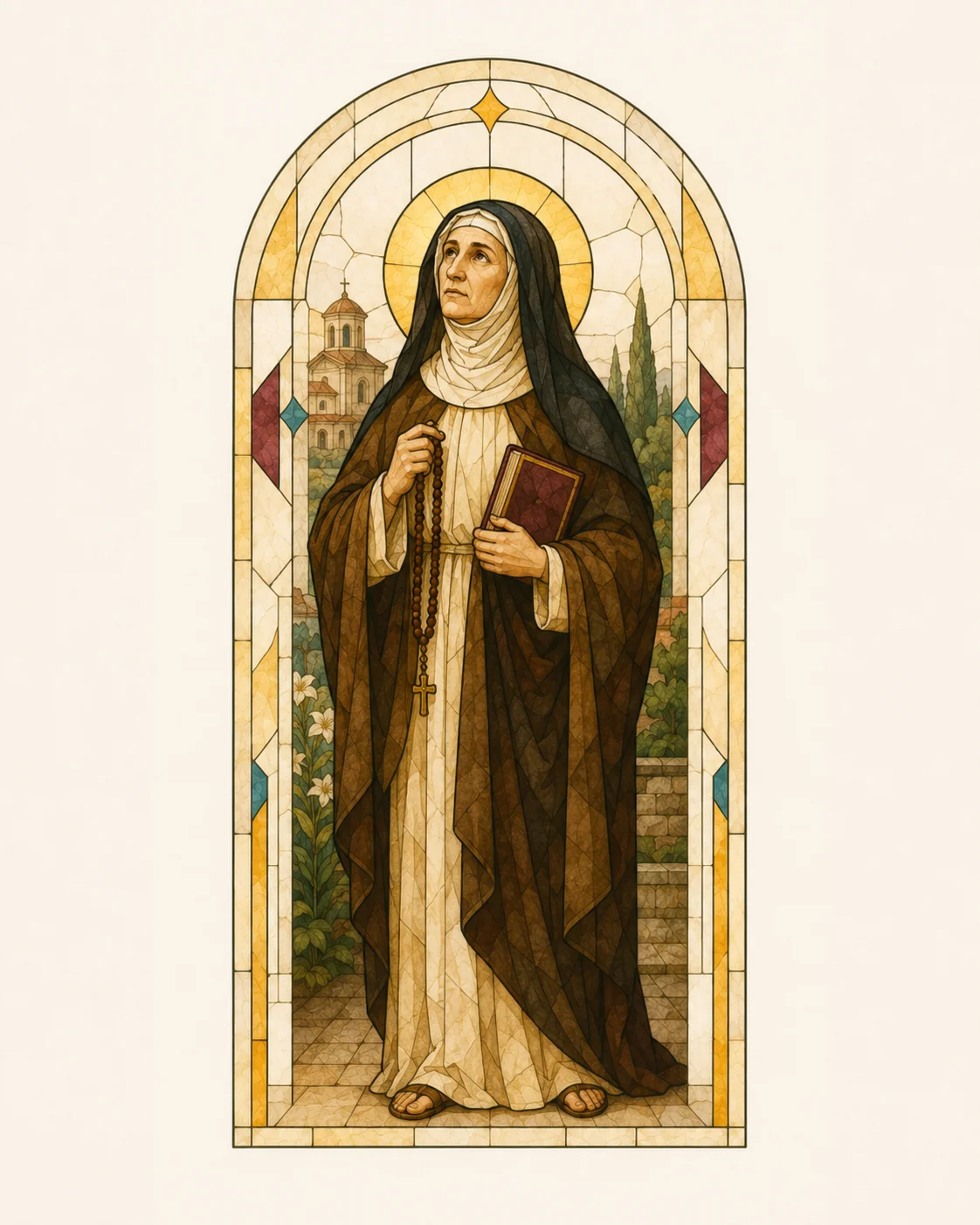
A faithful wife and mother whose patient love, honest counsel and persevering prayer accompanied her family towards Christ, St Monica is remembered especially for witnessing the conversion and baptism of her son Augustine.
Saint19th–20th century · Feast May 29
The pope who brought the Second Vatican Council to completion and carried its reforms into a period of conflict and change.
Saint16th–17th century · Feast September 27
A French priest who transformed ambition into organised, practical charity and founded enduring communities serving people in poverty.