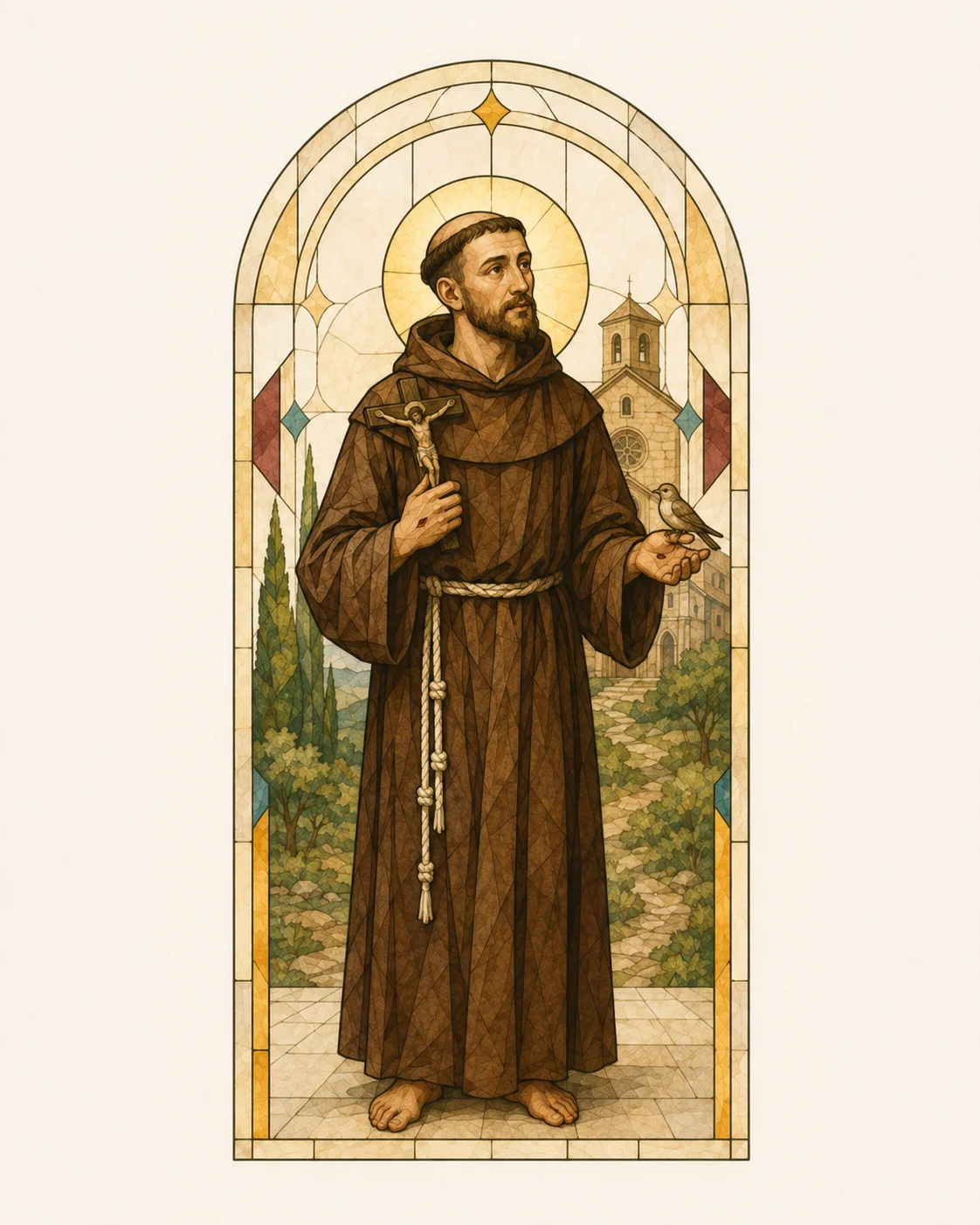
St Francis of Assisi
Saint12th–13th century · Feast October 4
A merchant’s son who embraced radical Gospel poverty, St Francis founded the Franciscan movement and found joyful fraternity with the poor, the Church and all creation.
SaintNot applicable · Feast September 29
Also known as Michael, Archangel Michael, Saint Michael, St Michael, Michael the Archangel, Holy Archangel Michael, Mikha’el
The archangel who stands for the unmatched sovereignty of God, St Michael appears in Scripture as defender of God’s people and leader of the heavenly hosts against the powers of evil.
Almighty God, you give your angels the mission of serving your saving purpose. Through the intercession of St Michael the Archangel, protect us from deception, fear and every temptation to abandon what is right. Give courage to those who defend the vulnerable, wisdom to everyone entrusted with authority and peace to those who feel threatened. Keep us humble before you, confident in Christ’s victory and faithful in every spiritual struggle. Amen.
St Michael is one of the three angels named in the canonical Scriptures, together with Gabriel and Raphael. Unlike human saints, he has no earthly birth, nationality, physical biography or date of death. Catholic teaching identifies angels as created spiritual beings who possess intelligence and will, glorify God and serve his saving purpose.
The word “angel” describes a mission rather than a biological species or human occupation. It means messenger. Angels are not deceased human beings who have become spirits, nor are they divine beings competing with God. They are creatures whose dignity comes entirely from God and whose faithful service directs attention towards him.
Michael’s name comes from the Hebrew Mikha’el and means “Who is like God?” The name is best understood as a challenge to every form of pride, idolatry and rebellion. No creature, earthly or spiritual, can take the place of the Creator.
Michael first appears by name in the Book of Daniel. During a vision, a heavenly messenger tells Daniel that Michael, described as one of the chief princes, came to his assistance during opposition from the prince of Persia.
The language belongs to the apocalyptic and symbolic world of Daniel, in which earthly conflicts are shown to possess a spiritual dimension. Michael is not presented as an independent god of war but as a servant acting within God’s providence.
Daniel later identifies Michael as the prince associated with Daniel’s people. In the book’s final vision he is called the great prince who stands guard over them during a period of severe distress.
These passages formed the biblical foundation for understanding Michael as a protector of God’s people. Christian tradition later applied that protective role particularly to the Church, the people gathered in Christ.
The Letter of Jude explicitly calls Michael an archangel. It refers to a dispute between Michael and the devil concerning the body of Moses, an episode drawn from an ancient Jewish tradition not narrated elsewhere in the canonical Bible.
Michael’s conduct in Jude is important. Although confronting the devil, he does not presume to pronounce an abusive judgement through his own authority. Instead, he says, “May the Lord rebuke you.”
This passage presents genuine spiritual authority as humble and obedient. Michael does not rely upon contempt, uncontrolled anger or personal power. He entrusts judgement to God.
The Book of Revelation provides the best-known biblical image of Michael. Revelation describes war in heaven, with Michael and his angels fighting against the dragon and its angels. The dragon is identified as the ancient serpent, the Devil and Satan.
Michael’s forces prevail, and the dragon is cast down. Yet the surrounding hymn makes clear that salvation, power and kingship belong to God and his Anointed. The victory is achieved through the blood of the Lamb and the faithful witness of those who belong to Christ.
Michael therefore must never be presented as a rival saviour or an independent source of supernatural power. His victory participates in and points towards the victory of Jesus Christ.
Revelation’s imagery has deeply shaped Christian art. Michael is frequently shown wearing armour, carrying a sword or spear and standing over a dragon. These are theological symbols rather than a physical portrait of an angel.
The armour represents vigilance and spiritual struggle. The dragon represents Satan and the forces opposed to God. Michael’s posture expresses the truth that evil is real but does not possess equal power with God.
The Church venerates Michael as a saint because “saint” fundamentally means holy. The term is not restricted to human beings who lived on earth. Michael is a holy angel who remains perfectly faithful to God and participates in the communion of heaven.
Veneration of Michael developed early within both Eastern and Western Christianity. Churches, shrines and liturgical celebrations were dedicated in his honour, and he became especially associated with protection, healing, the defence of churches and care for the dying.
September 29 was historically connected with the dedication of a church or basilica in honour of Michael. In the present Roman calendar, the date celebrates Michael together with Gabriel and Raphael, the three archangels named in Scripture.
One of the most influential centres of Western devotion arose on Monte Gargano in southern Italy. According to a longstanding local tradition, Michael appeared there near the end of the fifth century and indicated that the cave should become a place of Christian worship.
The sanctuary at Monte Sant’Angelo became one of medieval Europe’s major pilgrimage destinations. The traditional apparitions are commemorated locally on May 8, while September 29 is connected with the basilica’s dedication and the wider feast of the archangels.
Devotion to Michael spread through many countries and cultures. Churches were often dedicated to him in elevated or strategically significant locations, symbolising vigilance and protection.
He became particularly associated with soldiers, guards, police officers and others entrusted with defending communities. This association should not be interpreted as approval of aggression or unjust violence. Michael serves God’s justice; he does not represent violence pursued for pride, conquest or revenge.
Christian tradition also invokes Michael near death. Funeral prayer asks that angels lead the departed into paradise, and artistic traditions sometimes show Michael accompanying or weighing souls. The scales frequently placed in his hand belong principally to later devotional art rather than to a direct biblical description.
The well-known Prayer to St Michael was written by Pope Leo XIII. It asks the archangel to defend the faithful in spiritual battle and to act only “by the power of God.” The wording correctly places Michael’s authority beneath God’s sovereignty.
The prayer became especially familiar after Mass in the older Roman practice and remains widely used privately. Pope Francis encouraged its use when asking the Church to pray for protection from the devil’s accusations and divisions.
Authentic devotion to Michael does not involve fascination with demons, fear-driven superstition or attempts to control spiritual forces. It centres upon trust in God, resistance to temptation, fidelity to Christ and prayer for protection.
Catholic teaching acknowledges the reality of evil and spiritual temptation while also requiring prudence. Not every illness, misfortune, disturbing thought or psychological difficulty should be interpreted as demonic activity.
The Church distinguishes ordinary prayer for protection from the solemn rite of exorcism. A solemn exorcism may be carried out only by a priest who has received explicit permission from the local bishop. Individuals should not attempt private confrontations with alleged spirits or treat professional medical care as unnecessary.
Michael’s biblical witness is therefore one of confidence rather than panic. His name announces that no created power is equal to God. His conduct in Jude shows restraint and submission to divine judgement. His victory in Revelation belongs to the triumph of Christ.
For Christians, St Michael represents courageous fidelity, disciplined protection of the vulnerable and refusal to cooperate with evil. He points beyond himself towards the God whose authority, mercy and victory are final.
Scripture names Michael in Daniel 10 and 12, Jude 9 and Revelation 12. Daniel presents him as a chief prince and protector; Jude calls him archangel; Revelation depicts him leading the heavenly forces against the dragon. Catholic teaching insists that angels are created spiritual servants of God, while Revelation places the ultimate victory in God and the blood of the Lamb.
The Gargano accounts belong to longstanding Christian tradition rather than canonical Scripture. The sanctuary itself continues to observe the May 8 commemoration. The Prayer to St Michael is attributed to Leo XIII and explicitly invokes Michael’s action through God’s power.
The biblical texts concerning Michael emerged within Jewish and early Christian traditions that understood earthly history as part of a wider spiritual struggle between fidelity to God and resistance to his purposes.
The Book of Daniel uses apocalyptic visions, symbolic figures and heavenly interpreters to encourage a people facing oppression. Michael’s role as prince and protector belongs within this symbolic presentation of God’s care for his people.
The Letter of Jude draws upon an ancient Jewish tradition concerning Moses. Its use of that tradition does not turn the lost source into canonical Scripture; Jude incorporates the episode to teach humility and restraint in the face of spiritual powers.
Revelation was written for Christians experiencing pressure, persecution and conflict with imperial power. Its visions reveal that the apparent dominance of evil is temporary and that final victory belongs to God and the Lamb.
Early Christians inherited Jewish belief in angels while insisting that worship belongs to God alone. Angels are honoured as servants of God, not adored as divine beings.
As devotion to Michael developed, churches and shrines connected his biblical role with protection, healing, pilgrimage and prayer for the dead. The Gargano sanctuary became especially influential in medieval Europe.
Military imagery became prominent because Revelation depicts Michael in battle. In Christian theology this battle is first spiritual: truth against deception, fidelity against rebellion and the sovereignty of God against the pride that seeks to replace him.
The Catechism teaches that the existence of spiritual, non-corporeal angels is a truth of faith and that the Church joins them in worship of God while invoking their assistance. Revelation’s imagery identifies the dragon as Satan and attributes victory to God’s kingdom and the authority of Christ.
Complete fidelity to God; humility before divine authority; courageous resistance to evil; protection of God’s people; disciplined spiritual vigilance; obedience; justice without hatred; defence of truth; service rather than self-glory; and confidence that every victory over evil belongs ultimately to Jesus Christ. Michael’s name and scriptural role express the primacy of God. Even when confronting the devil in Jude, he does not claim independent authority but leaves rebuke to the Lord.
St Michael speaks especially to people entrusted with protecting others: police officers, soldiers, security personnel, prison officers and people responsible for public safety.
His example challenges them to exercise authority under moral law rather than treating power as permission for aggression, revenge or abuse.
He is meaningful to people experiencing intimidation, persecution or pressure to participate in wrongdoing. Michael represents the courage to remain loyal to what is true even when evil appears organised and powerful.
His name is particularly relevant when success, wealth, technology, politics or personality begin to occupy the place that belongs to God. “Who is like God?” confronts every form of pride and idolatry.
Michael can accompany people struggling with temptation, destructive habits or persistent pressure to compromise their conscience. His witness encourages vigilance without despair and courage without hatred.
He also speaks to parents and caregivers concerned for the safety of people entrusted to them. Prayer for protection should be joined with responsible practical action rather than used as a replacement for it.
His association with spiritual warfare requires careful handling. Christian spiritual warfare is not an excuse to become obsessed with demons, accuse other people of possession or interpret every disagreement as supernatural attack.
People experiencing paranoia, hallucinations, intrusive thoughts, trauma or severe anxiety deserve compassionate medical and psychological care. Seeking such care is not evidence of weak faith.
The Church’s solemn rite of exorcism is not a private spiritual technique. It belongs to the Church’s authorised pastoral ministry and may be performed only by a priest specifically permitted by the bishop.
Michael’s military appearance should never be used to glorify cruelty. Revelation’s victory is connected with the blood of the Lamb and faithful witness, not domination for its own sake.
For Christians who feel frightened by the existence of evil, Michael offers reassurance. Evil is neither imaginary nor equal to God. God remains sovereign, Christ has conquered, and the faithful are called to resist evil through truth, prayer, virtue and love.
The USCCB explains that solemn exorcism belongs to the Church’s sacramental ministry and is restricted to an authorised priest. Pope Francis has presented Michael’s role as protecting the mystery of Christ’s incarnation, death and resurrection rather than encouraging fascination with evil.
People turn to St Michael the Archangel in matters of:
Biblical era
The Book of Daniel identifies Michael as one of the chief princes and protector of God’s people.
1st century AD
The Letter of Jude identifies Michael as the archangel who entrusts judgement of the devil to the Lord.
1st century AD
Revelation depicts Michael and his angels battling the dragon within its vision of Christ’s victory over evil.
c. 490–493
Traditional apparitions associated with St Michael lead to the establishment of the sanctuary on Monte Gargano.
6th century
September 29 becomes associated in the Roman tradition with the dedication of a church in honour of St Michael.
16th century
Pope Pius V establishes the May 8 commemoration of the Gargano apparition within the Roman liturgical tradition.
late 19th century
Pope Leo XIII composes the Prayer to St Michael the Archangel.
1969
The revised General Roman Calendar joins Michael, Gabriel and Raphael in one Feast on September 29.
5 July 2013
A statue of St Michael is inaugurated in the Vatican Gardens as Vatican City is entrusted to the protection of St Joseph and St Michael.
29 September 2018
Pope Francis asks Catholics to conclude the October Rosary with the Prayer to St Michael.
September 29 · Feast · Global
Saints Michael, Gabriel and Raphael, Archangels
Feast in the General Roman Calendar
Celebrated together with St Gabriel the Archangel and St Raphael the Archangel
29 September is the Feast of Saints Michael, Gabriel and Raphael, the three archangels named in Sacred Scripture. This is one shared observance linked to all three archangels and has proper liturgical texts and readings.
May 8 · Apparition commemoration · Local
Apparitions of St Michael the Archangel on Monte Gargano
Local feast at the Sanctuary of St Michael the Archangel on Monte Gargano
Italy
Source-quality status: verified

Saint12th–13th century · Feast October 4
A merchant’s son who embraced radical Gospel poverty, St Francis founded the Franciscan movement and found joyful fraternity with the poor, the Church and all creation.
Saint · Feast September 29
The archangel sent to announce God’s saving work, especially the conception of Jesus to the Blessed Virgin Mary.

Saint15th century · Feast May 30
A teenage laywoman who answered an extraordinary call through prayer and courageous action, St Joan helped secure the coronation of Charles VII and remained faithful through capture, an unjust trial and death.
Saint20th–21st century · Feast October 22
A Polish pope whose experience of war and totalitarianism shaped a global ministry centred on human dignity, hope, young people and confidence in Christ.
Saint19th–20th century · Feast September 23
A Capuchin priest known for long hours of prayer, confession, spiritual guidance and patient endurance of illness and scrutiny.
Saint · Feast September 29
The archangel who accompanies Tobias in Tobit, bringing guidance, healing and restoration to a family.