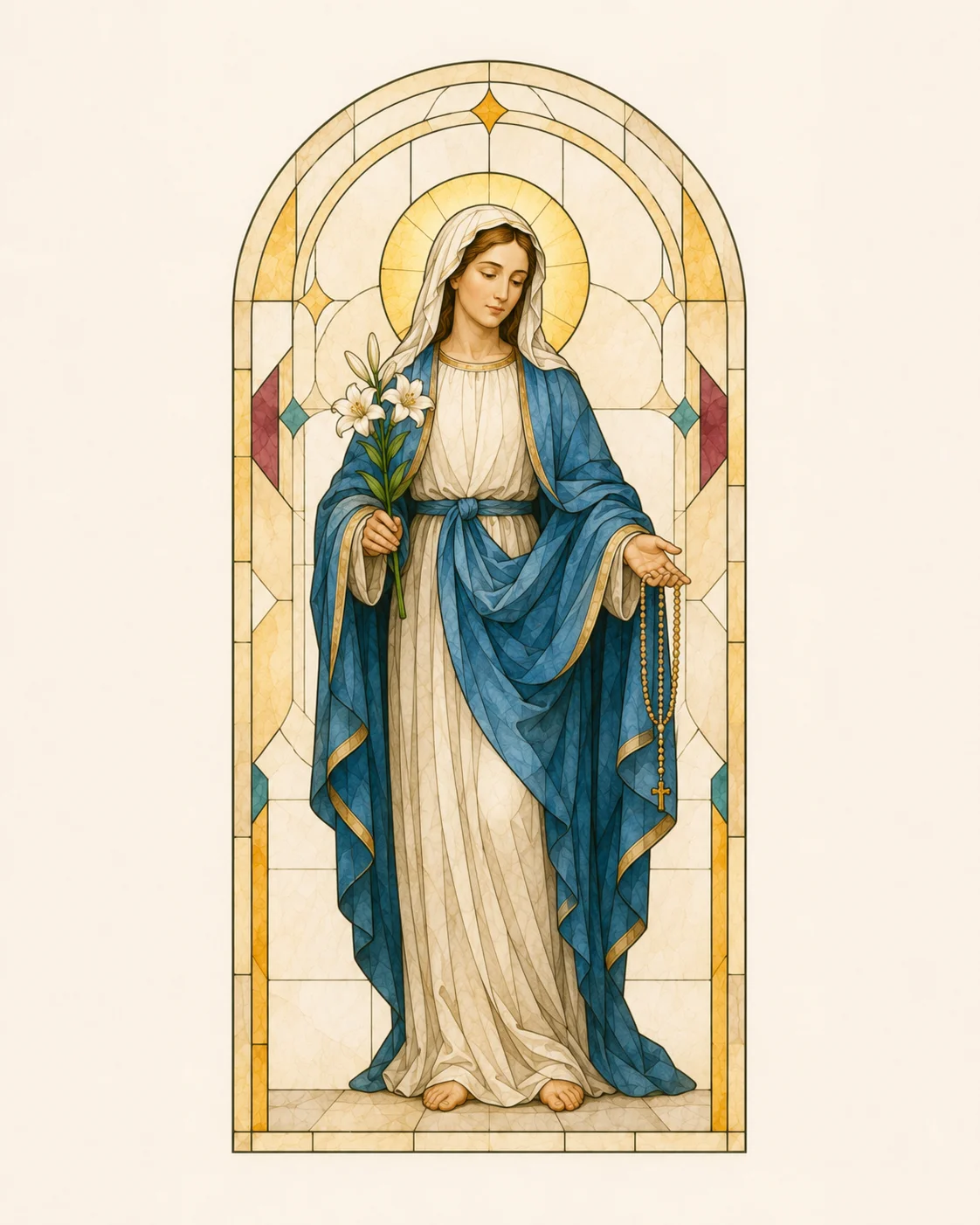
St Mary Magdalene was one of the most prominent women in the Gospel accounts of Jesus’ ministry, Passion and Resurrection. Scripture presents her as a healed disciple, a practical supporter of Jesus’ mission, a faithful witness at the Cross and burial and the first person sent to announce the risen Christ to his disciples. The Church therefore honours her with the ancient title “Apostle of the Apostles.”
Her personal name was Mary, or Miriam in its Semitic form. “Magdalene” was not a surname in the modern sense. It probably identified her with Magdala, a settlement on the western shore of the Sea of Galilee, and distinguished her from the several other women named Mary in the Gospels. Scripture does not explicitly say that she was born in Magdala or provide information about her family, marital status or occupation.
Luke first names Mary among a group of women who accompanied Jesus and the Twelve. These women had been healed of evil spirits and infirmities and supported the ministry from their own resources. Mary is identified as the woman “from whom seven demons had gone out.” The Gospel does not narrate the healing itself or explain the precise nature of her suffering.
The reference to seven demons communicates the seriousness of the affliction from which Mary was delivered, but it must not be converted into a diagnosis. Scripture does not say that she had committed sexual sins, worked as a prostitute or suffered from a particular modern psychiatric condition. Demonic affliction in the Gospel is not presented as evidence of moral guilt, and Mary’s healing must not be used to stigmatise people experiencing mental illness, trauma or neurological conditions.
Luke’s account also shows that women were not merely passive observers of Jesus’ ministry. Mary and her companions travelled with the group and contributed materially to its needs. Supporting the ministry from their resources suggests some degree of financial agency, but the text does not establish that Mary was exceptionally wealthy or independent. Her discipleship combined personal devotion with practical generosity.
Mary next becomes especially visible during the Passion. Matthew and Mark name her among the women who watched the Crucifixion after having followed Jesus from Galilee and ministered to him. John also places Mary Magdalene among the women near the Cross. The accounts arrange the witnesses differently, but all preserve her presence when Jesus was executed.
Her presence does not mean that she experienced no fear or confusion. Remaining near the Cross exposed her to grief, danger and apparent defeat. Her fidelity consisted not in controlling the outcome but in refusing to treat Jesus as forgotten when his public ministry appeared to have ended in disgrace.
Mary also witnessed Jesus’ burial. Matthew places her and “the other Mary” opposite the tomb after Joseph of Arimathea laid Jesus’ body there. Mark similarly names Mary Magdalene and Mary the mother of Joses as watching where he was laid. Their knowledge of the burial place connects the reality of Jesus’ death with their later discovery of the empty tomb.
After the Sabbath, Mary Magdalene returned to the tomb. Mark says that she, Mary the mother of James and Salome brought spices to anoint Jesus’ body. Matthew names Mary Magdalene and the other Mary. Luke identifies Mary Magdalene, Joanna, Mary the mother of James and other women as those who reported what they encountered. The evangelists select and arrange details differently, but every Gospel places Mary Magdalene at the heart of the Easter discovery.
John gives the fullest individual account. Mary arrived while it was still dark and saw that the stone had been removed. Believing that Jesus’ body had been taken, she ran to Simon Peter and the beloved disciple. After they visited the tomb and departed, Mary remained outside weeping.
She looked into the tomb and saw two angels where Jesus’ body had lain. When they asked why she was weeping, she answered that her Lord had been taken away and that she did not know where he had been placed. She then turned and saw Jesus but did not initially recognise him, supposing him to be the gardener.
Recognition came when Jesus called her by name: “Mary.” She answered, “Rabbouni,” meaning Teacher. The encounter reveals both the continuity and newness of the Resurrection. The person before her was truly the Jesus she loved, yet his risen life could not simply be possessed or restored to the conditions that existed before the Cross.
Jesus’ words traditionally translated “Do not touch me” are more accurately understood as “Stop holding on to me” or “Do not cling to me.” They are not a rejection of Mary, a condemnation of affection or a declaration that she was impure. Jesus entrusted her with a mission: she was to go to his brothers and announce his return to the Father.
Mary obeyed and told the disciples, “I have seen the Lord.” The woman whose first report about the missing body had emerged from grief now proclaimed the central truth of Christian faith. Her witness did not depend upon possessing social rank or belonging to the Twelve. It depended upon encountering the risen Christ and faithfully delivering the message entrusted to her.
Matthew likewise presents the risen Jesus meeting the women and sending them to tell his brothers to go to Galilee. Luke records that the Apostles initially regarded the women’s report as nonsense. Their dismissal forms part of the Gospel account rather than undermining the women’s testimony. The Resurrection narratives deliberately preserve women as the first heralds of Easter even within a society in which religious and public authority was usually held by men.
The Church consequently calls Mary Magdalene the “Apostle of the Apostles.” St John Paul II described her as the first eyewitness of the risen Christ and the first to bear witness to him before the Apostles. Rabanus Maurus and St Thomas Aquinas used the Latin expression apostolorum apostola because she announced to the Apostles what they would proclaim throughout the world.
The title does not make Mary one of the Twelve or give her the technical liturgical descriptor Apostle. It recognises the distinctive Easter mission she received directly from Christ. Her witness remains essential to the Church’s proclamation and demonstrates that Christ entrusts the truth of the Gospel to women as well as men.
The New Testament does not provide a reliable account of Mary’s life after Easter. She may have remained among the wider community of disciples, but Acts does not name her individually. Claims that she preached in Rome, lived with St John in Ephesus or travelled to Provence belong to later traditions and cannot be presented as documented biography.
Eastern tradition associates Mary with Ephesus and remembers her as a Myrrhbearer and Equal-to-the-Apostles. Medieval Western tradition developed an elaborate account in which Mary, Martha, Lazarus and companions travelled to southern Gaul. Mary was said to have spent her final years in prayer at Sainte-Baume and to have been buried near Saint-Maximin. These traditions produced important shrines and centuries of devotion, but surviving evidence cannot establish where she actually died or authenticate competing relic claims.
A further Western tradition identified Mary Magdalene with two other Gospel women: Mary of Bethany, the sister of Martha and Lazarus, and the unnamed sinful woman who anointed Jesus’ feet in Luke 7. Preaching associated with Pope St Gregory the Great helped popularise this composite interpretation in the late sixth century. It inspired powerful art and spirituality centred upon repentance and contemplative love.
The identification was never stated explicitly in Scripture, however. Luke introduces Mary Magdalene by name only after the account of the unnamed woman, without saying that they are the same person. Mary of Bethany is consistently identified through her family and village. The modern Roman liturgy therefore commemorates Mary Magdalene on 22 July and Saints Martha, Mary and Lazarus of Bethany on 29 July as distinct biblical figures.
Mary Magdalene must likewise not be confused with the woman caught in adultery in John 8. That passage does not name the woman, and it never connects her with Mary. Scripture also provides no evidence that Mary Magdalene was married to Jesus or involved in a romantic relationship with him. Later non-canonical writings that use Mary as a prominent disciple were composed too late to establish such a marriage.
Mary’s genuine story is already extraordinary without these additions. She experienced profound healing, committed her resources to Christ’s mission, remained present during his suffering, sought him even when she believed only his body remained and accepted the task of proclaiming a reality larger than her grief. Her witness moves from deliverance to discipleship, from service to steadfast presence and from mourning to mission.
The Gospel does not reduce Mary Magdalene to her past. Nor does it present her merely as a symbol of private repentance. Jesus calls her by name and entrusts her with the news that gives birth to the Church’s Easter proclamation. Her identity is defined finally by grace, faithful love and truthful witness: “I have seen the Lord.”